
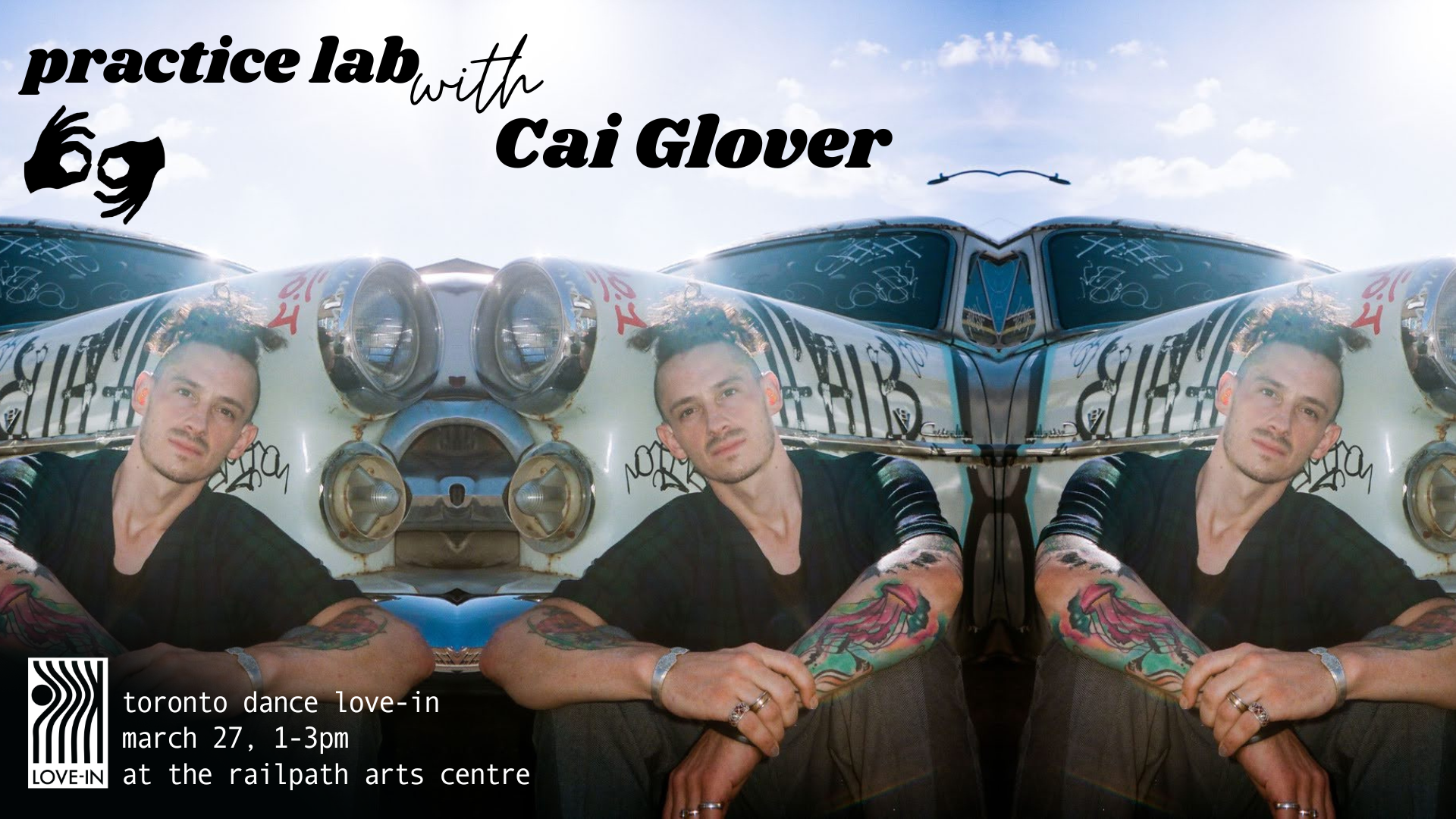
Practice Lab
Poetics of Movement
with Cai Glover
when
March 27, 2026
at 1:00-3:00pm ET
where
The Railpath Arts Centre
35 Golden Ave, Toronto, ON M6R 2J4
accessibility
The Railpath Arts Center has an accessible entrance and the studios and washrooms are accessible to wheelchair and mobility device users. The closest public transportation are the 506 and 505 streetcars, with stops at Dundas West & Sorauren Ave or Howard Park.
There will be 2 ASL Interpreters at the session.
If there is anything we can do to help someone access this space, please email us at info@tolovein.com.
about the session
This all-levels session will explore transposing of language into movement. How does the body express specific meanings of language? Is there something more that is captured when the body engages in motion that can’t be grasped by the literal? This session doesn’t focus on dance techniques but rather, focuses on the individual's emotional experiences to bring meaning to the movement we create. We will be using some ASL (American Sign Language) to get more fully and directly into the body by exploring a gestural and spatial language. Here the body discovers its vast network of communicative powers in a non-verbal form, abstracted by poetry and enhanced by meaning.
about the artist
Cai Glover is a Montreal-based dance artist, choreographer, and artistic director whose work foregrounds the poetics of movement, language, and embodied identity. He has been developing his creative practice for over 25 years, and for more than a decade worked as a performer, interpreter, and choreographer with Cas Public, contributing to multiple company creations before expanding his independent practice.
As the founder and artistic force behind A Fichu Turning, Glover explores how language and gesture might be transformed into an embodied movement vocabulary, using the dancing body to probe questions of meaning, perception, and social dynamics. His work investigates the politics of disability, Deaf culture, and sensory experience as sources of artistic poetics and identity.
As a Deaf artist, hearing differently has shaped both his creative approach and aesthetic voice, giving rise to performances and research that unsettle conventional sensory hierarchies in dance. Over his career, he has worked with a wide range of collaborators and continues to present choreographic work that invites audiences into movement practices at the intersection of expression and inclusion.